
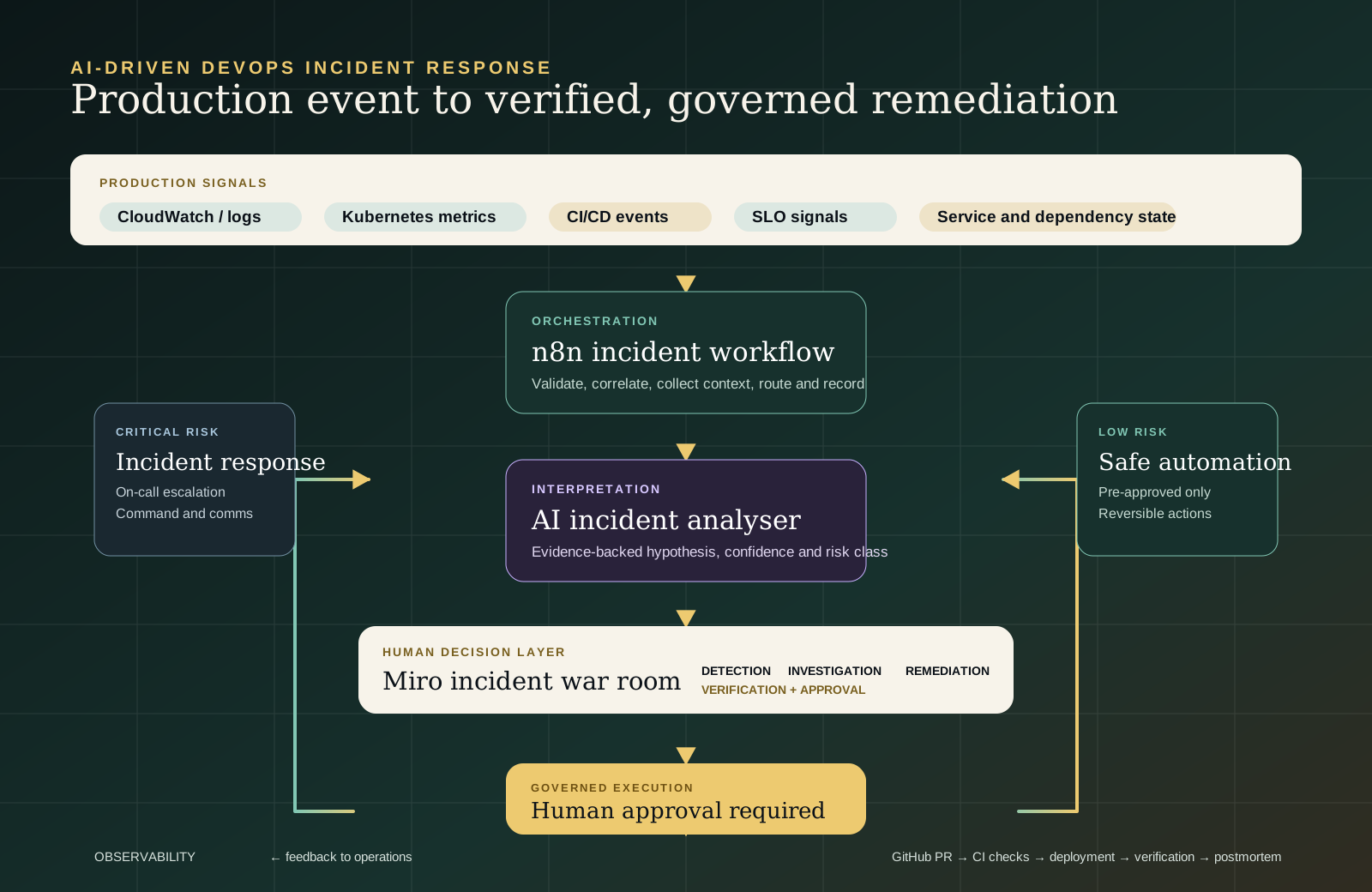
The useful question is not whether AI can react to an alert. It is how to turn a production event into a safe, reviewable, and traceable decision. n8n coordinates systems; AI interprets evidence; Miro gives people shared operational context; GitHub and CI/CD govern the change.
This is an AI-assisted DevOps control loop, not an automated whiteboard. Observability, source control, infrastructure, and the incident record remain authoritative. The automation reduces the time from signal to an informed action without bypassing engineering judgment.
01 / The pattern
Make Miro the human-facing layer of an operational control loop
A production event begins in observability, not in Miro. n8n receives and normalises the alert, gathers targeted context, and records the incident. The AI agent returns a constrained root-cause hypothesis and recommended next steps. Miro then renders the evidence, ownership, and pending decision for the incident team.
Validate alerts, collect context, route decisions, and maintain idempotent workflow state.
Summarise evidence, propose a root cause, assess risk, and recommend constrained actions.
Make detection, investigation, approval, and verification clear to the people on call.
Review, test, scan, deploy, and retain a permanent record of production change.
02 / Example
Investigate a production incident instead of forwarding a generic alert
Consider a payment API where error rate rises to 15.3%, CPU reaches 95%, pods restart repeatedly, and database connections jump after a recent deployment. A simple “CPU alert” forces an engineer to assemble that story manually. The control loop collects and presents the related evidence before it suggests a response.
Production signals are inputs to an investigation, not instructions to modify a live system.
The incident board connects the affected service, deployment, dependencies, SLO state, evidence, owner, and recommended action. That makes the likely blast radius and the decision history visible to the whole incident team.
{
  "incident_id": "INC-2026-0830",
  "service": "payment-api",
  "environment": "production",
  "error_rate": 15.3,
  "cpu_percent": 95,
  "pod_restarts": 18,
  "db_connections": 127,
  "deployment": "v2.8.1"
}
03 / Workflow
Build a workflow that produces reliable incident context
Each stage should have one responsibility, an inspectable input and output, and a durable correlation ID. The workflow is deliberately conservative: it proposes actions quickly, but it does not grant itself broad production access.
Authenticated alert
  ↓
Validate, normalise, and create or update incident record
  ↓
Collect targeted context: logs, metrics, deployment, runbook, topology
  ↓
AI incident analysis → schema validation → risk classification
  ↓
Create or update Miro incident board
  ├─ low risk, pre-approved and reversible → controlled automation
  ├─ medium risk → human approval → GitHub pull request
  └─ critical risk → incident response and on-call escalation
  ↓
Verify outcome → update incident record → postmortem and knowledge base
1. Collect evidence before model analysis
Retrieve only the context required for this incident: a time-bounded log sample, relevant metrics, recent deployments, service ownership, dependencies, and a matching runbook. Persist the original alert and the retrieved evidence before asking the model to interpret it.
2. Request a schema, not prose
Constrained output is easier to validate, route, and audit. Require a confidence value, cited evidence identifiers, an explicit risk class, and an insufficient-evidence outcome. The AI result is a hypothesis for the team, not an autonomous root-cause declaration.
{
  "probable_root_cause": "Database connection pool exhaustion",
  "confidence": 0.87,
  "severity": "high",
  "evidence_ids": ["metric-42", "log-88", "deploy-19"],
  "recommended_actions": ["rollback v2.8.1", "inspect connection leak"],
  "requires_human_approval": true
}
3. Make risk explainable
Calculate the action path from a versioned policy, not a model preference. Severity, confidence, SLO or error-budget status, affected environment, reversibility, and blast radius should determine whether the item is escalated, approved by a person, or eligible for a narrowly pre-approved remediation.
04 / Decision design
Use Miro as a visual incident war room
Organise the board around the decision: Detection, Investigation, Remediation, and Verification. Each card should link back to the durable incident record, source evidence, and change request rather than copying sensitive logs or credentials into the board.
INCIDENT WAR ROOM
Detection          Investigation          Remediation          Verification
─────────          ─────────────          ───────────          ────────────
HTTP 500: 15.3%    DB connections high    Rollback proposed    Error rate normal
CPU: 95%           Deployment v2.8.1      Owner: on-call       SLO recovering
Started: 14:32     Confidence: 87%         Approval: pending    Postmortem queued
Human review is the control point. The approver should be able to see the hypothesis, supporting evidence, risk classification, intended change, rollback plan, and current SLO state before authorising a remediation.
05 / Governed execution
Use GitOps for material production changes
Do not give an AI agent unrestricted shell access to production. For configuration, infrastructure, or application changes, create a GitHub pull request with the proposed diff, incident link, evidence summary, and rollback plan. CI then runs tests, security scanning, and policy checks before a human-approved deployment proceeds.
AI recommendation → GitHub pull request → human review
                                        ↓
                              CI tests and security checks
                                        ↓
                             infrastructure or application deploy
                                        ↓
                         health checks, SLO evaluation, observability
This keeps source control and CI/CD as the systems that execute and record change. n8n can coordinate notifications and state transitions, while Miro continues to hold the shared decision context.
06 / Production guardrails
Design the controls before scaling the loop
- Authenticate every event. Verify alert or webhook signatures and scope each integration to the minimum required permissions.
- Protect data boundaries. Minimise telemetry sent to the model, redact secrets and personal data, and never place credentials in workflow expressions or boards.
- Use stable correlation IDs. Persist the alert, incident, Miro item, pull request, deployment, and verification IDs so retries update rather than duplicate the work.
- Set explicit SLO policy. Include availability, latency, error-rate, and error-budget state in the risk policy. An exhausted error budget can freeze non-essential releases.
- Limit automatic remediation. Restrict it to pre-approved, reversible, well-observed actions with a tested rollback. Escalate everything else.
- Close the learning loop. Record decisions, outcomes, and postmortems in the incident system and knowledge base so future investigations improve.
07 / Next step
Start with one service and one safe decision
Prototype the loop around a single production service, a small set of alerts, and one human-approved remediation path. Measure time to context, approval time, recovery time, and false-positive rate. Expand only after the evidence, controls, and rollback path are dependable.
The architecture remains simple: observability detects, n8n coordinates, AI interprets, Miro helps people decide, GitOps governs change, and verification closes the loop.
Stay up to date
Get new engineering notes by email.
Occasional, practical writing on engineering, automation, data, and product strategy.