
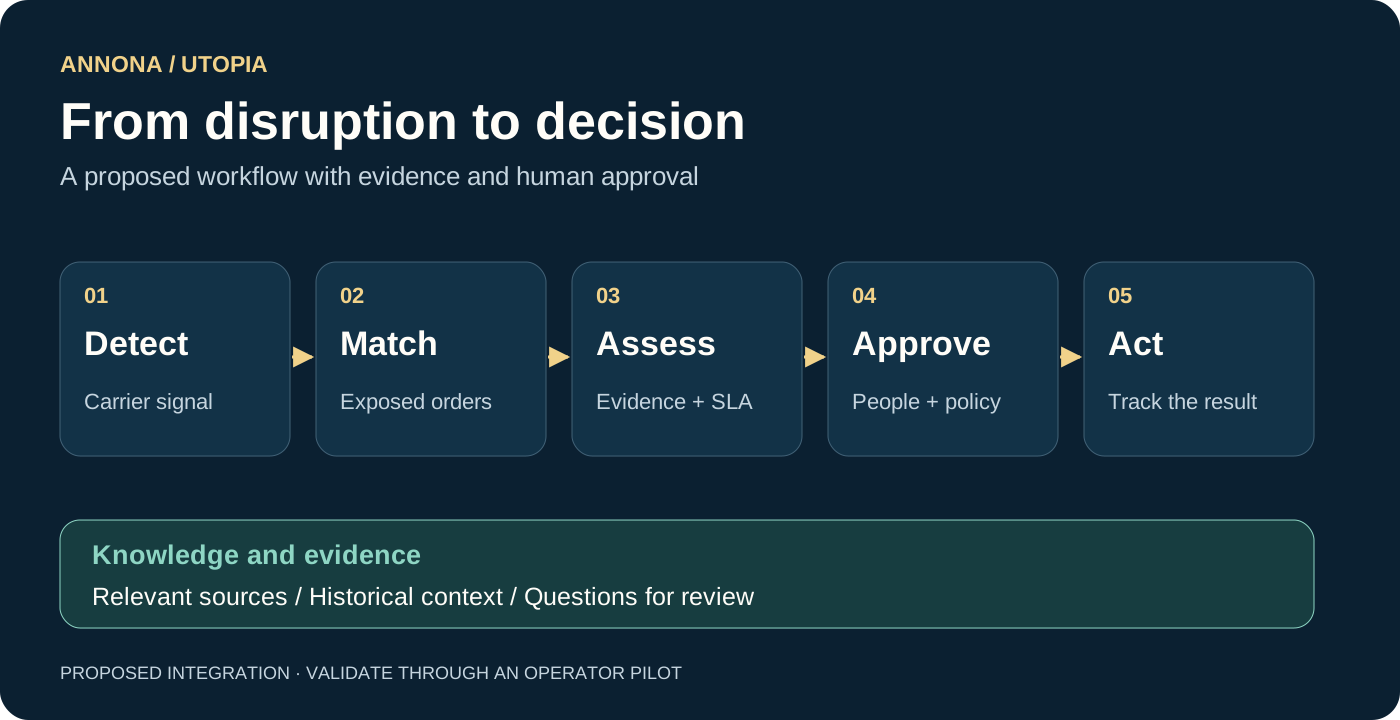
A logistics recommendation becomes useful when an operator can see which orders are exposed, inspect the evidence, and understand what approving the next step will change.
This is a proposed architecture for Annona and DeepLethe’s Utopia. Annona’s public walkthrough uses sample scenarios; the integration described here has not been implemented or benchmarked for this article. The examples illustrate a design that a focused pilot could test. Start with the 2-minute-15-second video walkthrough, then follow the evidence and approval responsibilities through the design.
01 / The decision
A disruption becomes a question about customer commitments
Imagine a shipping corridor slowing down during a busy delivery week. A carrier issues a notice, another source reports congestion, and an operations manager has a meeting with a customer in an hour. Several containers may be affected. Some orders have delivery buffer; others contain stock a customer needs to keep operating.
The immediate task is to establish what deserves attention. Which shipments actually use that corridor? Which customer promises are exposed? Is the carrier notice current? Would an alternative route improve the outcome enough to justify the additional cost? Who can approve that expense?
Those questions connect physical movement to commercial responsibility. A useful system has to carry that connection all the way through to the person making the decision. An impressive summary loses its value if the operator still has to reconstruct the shipment list, agreement, and evidence from scratch.
This is the opportunity explored here: combine Annona’s logistics workflow with a knowledge foundation that can preserve context, sources, and changes. The ambition is to make each operational decision easier to prepare, review, and explain.
02 / The operational gap
The evidence is spread across the workflow
Consider the information path in this example. A transport management system (TMS) holds a shipment plan. A warehouse management system (WMS) records readiness and inventory. A carrier publishes a revised schedule. A contract defines the service commitment. A Jira ticket records the investigation, while customer correspondence explains why one order needs special attention.
Each record can be accurate on its own while the combined picture remains incomplete. A warehouse update may arrive after a transport alert. A renamed customer may appear under different identifiers. An old attachment may contain terms that have since changed. Joining records without preserving those differences can make a confident recommendation misleading.
The design challenge is therefore both operational and informational. The system needs reliable joins between records, a way to show when information was last checked, and a review path for uncertainty. It also needs to let the next shift understand why an earlier team chose a particular response.
03 / Annona’s product direction
Connect the exception to a controlled response
Annona presents a logistics platform covering incidents, service-level agreement (SLA) risk, routing, disputes, audit preparation, and customer communication. Its Annona Moments workflow connects external disruptions to shipment exposure and proposed recovery actions. The public guided demo explicitly uses seeded scenarios until live shipment connectors and an external-intelligence API key are configured.
That product direction suggests a clear operational sequence: detect a relevant change, identify exposed orders, assess commitments, prepare options, obtain the required approval, and coordinate follow-through. In this design, Annona would own the shipment-specific calculations and the interface through which teams act.
The proposed Utopia integration would support the evidence work inside that sequence. Before choosing a response, an operator should be able to inspect the notice, agreement, or earlier incident that gives the recommendation its context.
Watch the logistics workflow
This silent concept walkthrough brings the operational journey into view: connect systems, investigate an exception, prepare evidence, compare routes, and update the customer. The recording uses LRM branding; the current Annona platform is linked above.
Download the video (MP4)Read the visual description
Text description of the silent walkthrough
The recording follows an LRM-branded logistics workspace. It opens with a sign-in screen and ends with a credit to Mohammed Roqa. The examples and figures below describe what is shown on screen.
- Sign-in and setup: an operations user signs in, then sees data-warehouse and Jira connection options.
- Operations overview: a dashboard displays shipment totals, exceptions, deliveries, and SLA adherence alongside incident summaries for weather, port congestion, and a customs hold.
- Exception review: a weather delay through Denver opens a shipment journey and an SLA risk score. A suggested reroute via Salt Lake City displays an estimated time benefit and additional cost, beside an execution button.
- Carrier disputes: a case list shows amounts and review states. A selected late-delivery dispute has an escalation timeline and an evidence-pack option referencing weather logs, the SLA agreement, and tracking history.
- Integration health: ERP, CRM, carrier, warehouse, and customs connections appear with API health, data streams, and webhook events, including a failed synchronisation.
- Route comparison: ocean-and-road, air-and-road, and multimodal options show cost, transit time, emissions, and scores. A shipment journey and an impact comparison illustrate the selected option.
- Analytics and reporting: shipment volumes, SLA trends, carrier scores, and cost and emissions figures are followed by a report-generation screen covering customs data, a carbon-offset calculation, and digital signatures.
- Customer view: a branded tracking page shows an estimated delivery date and milestones from dispatch through customs clearance and arrival at the destination port.
The connection to Utopia is the evidence behind these screens: the notice supporting an exception, the agreement used in a dispute, and the facts available when a response was chosen. Route calculations and execution would stay with Annona and its operational services. In the proposed design, changes to bookings, spending, or customer commitments require a recorded approval before execution.
04 / Utopia’s contribution
Give operational knowledge a source and a history
DeepLethe’s Utopia documents source-linked search, a knowledge graph, historical facts, and read-only retrieval tools exposed through the Model Context Protocol (MCP). Its bitemporal model records both when a fact applies and when the system learned it, preserving a correction history. These capabilities make it a candidate for the context Annona’s operators would need. Source: reviewed feature documentation.
For this design, a knowledge graph would connect familiar business objects: a shipment travels through a route segment, carries an order, uses a carrier, and serves a customer. A contract defines the relevant commitment. A notice supplies evidence about a disruption. The vocabulary and relationships would be agreed with the operator before relying on extracted records.
Time-aware storage preserves what was recorded; the quality of an extracted fact still depends on its source and review. A useful answer would include the source passage, relevant dates, and any unresolved ambiguity. If two documents disagree, the interface should help the operator examine both. The proposal should preserve the distinction between a reported event, an inferred relationship, and a confirmed operational fact.
That approach also creates a practical test: can the system retrieve the right agreement for the right shipment and date, with enough evidence for a person to verify the answer?
05 / Proposed architecture
Make ownership explicit from the first integration
I would connect Utopia as a knowledge service alongside Annona’s event processing. Annona would handle incoming shipment events, route exposure, SLA calculations, recovery options, and workflow state. Utopia would supply retrieved context and source history through a narrow integration boundary.
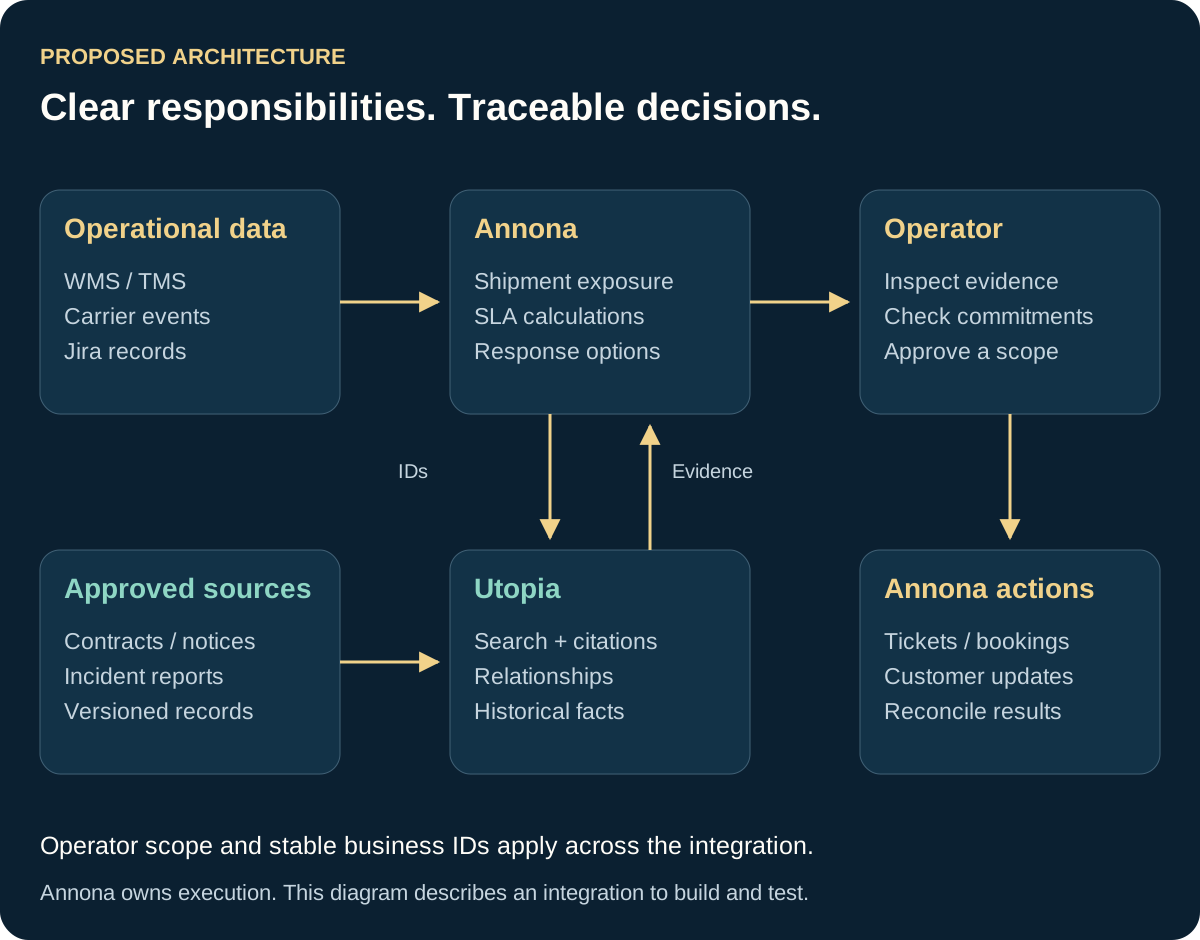
| Responsibility | Owner | Reviewable output |
|---|---|---|
| Shipment exposure and commitments | Annona | Affected orders, deadlines, and calculation inputs |
| Documents and historical context | Utopia | Source passages, relationships, and relevant dates |
| Record identity and access | Integration service | Canonical IDs, operator scope, and source versions |
| Cost and customer promises | Authorised operator | Approval, rejection, or requested revision |
| Execution and reconciliation | Annona | Action status, external reference, and verified result |
The shared record contract matters more than the first chat interface. Every item should identify the logistics company it belongs to, its stable business ID, source system, source version, event time, ingestion time, and access scope. A carrier’s display name alone is a weak join key. A shipment appearing in two systems should be reconciled through an explicit mapping.
For fast-changing information, the integration should declare freshness and ingestion status. Annona should be able to calculate exposure from authoritative operational records even when document processing is delayed. An incomplete knowledge result should remain visible as incomplete.
Utopia’s pipeline documentation separates searchable documents from subsequent graph extraction and documents extraction failures, rejected facts, and entity-matching limitations. Annona’s interface would need to communicate that readiness distinction, and a pilot would need to measure extraction errors on representative records. Source: processing pipeline.
Execution needs its own safeguards. A proposed reroute should have an expiry time, a cost estimate with a source, an approver, and a check that shipment conditions still match the proposal. Repeated requests should resolve to the same recorded action. After a timeout, reconcile the carrier’s booking status before retrying; an uncertain response can still mean a booking succeeded. These are Annona integration requirements to build and verify.
Each approval should preserve the source versions, calculation inputs, rule version, and selected option. Annona must then attach the execution result and external reference. A historical knowledge graph supports that record, but reproducing a logistics decision also requires the operational inputs and action history.
06 / Illustrative walkthrough
Follow one disruption through to a revised decision
The following scenario is hypothetical. The times and records illustrate the proposed behaviour; they are not results from an operating customer deployment.
09:00 — Capture the notice and identify possible exposure
A carrier publishes a delay advisory. Annona records the source, publication time, receipt time, and referenced service. Its operational matching identifies shipments using that service and the orders attached to them. Uncertain matches enter review. A report of regional congestion is supporting context, rather than sufficient proof that every shipment in the region is delayed.
09:15 — Assemble the evidence and customer commitments
Annona requests context for the affected orders: relevant agreements, service exceptions, earlier notices, and similar resolved incidents. Utopia could return passages and historical facts, while the integration keeps the operator’s access scope intact. Annona calculates remaining delivery buffer and identifies which commitments need attention.
The operator sees the exposed orders beside their evidence. A missing agreement or conflicting notice becomes a visible question. This review step gives the team a chance to correct a weak relationship before it influences a costly response.
10:00 — Compare options and record approval
Annona prepares a small set of options using validated operational inputs: continue monitoring, seek an alternative route, or investigate another transport mode for a priority order. Each option includes its assumptions, estimated cost, expiry, and expected effect. Routing and capacity checks would come from the relevant operational services.
An authorised manager approves a bounded response. Annona records the selected option, approver, calculation inputs, and references to the evidence versions used. A customer update can then explain the confirmed situation without converting an unverified estimate into a delivery promise.
11:30 — Reassess when the carrier corrects its estimate
The carrier publishes a revised notice. The proposed integration retains the earlier evidence and associates the update with it. Annona recomputes the affected assessment and asks whether the approved action is still appropriate. A material change in cost or commitment requires another review. If an action has already executed, Annona must show that state and prepare a feasible amendment or cancellation for approval.
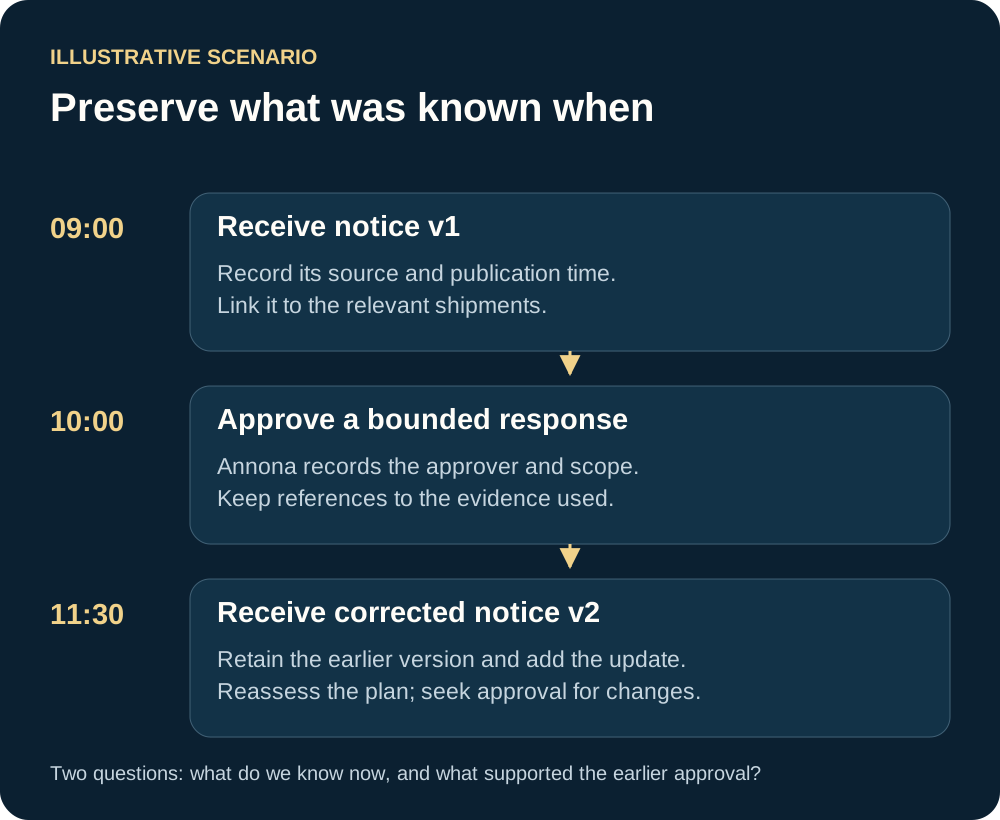
This separation is valuable during a later review. The team needs to know what the current evidence says and what information supported the earlier action. Connecting an approval to its evidence also makes the remaining uncertainty inspectable.
07 / Operational and commercial value
Make the benefit visible in the work operators already do
The proposed integration should earn its place through measurable improvements. Three workflows provide useful starting points because they have recognisable inputs, human reviewers, and outcomes that can be compared with the existing process.
Prepare the assessment
Reduce the time spent collecting notices, shipment context, and customer commitments before reviewing a recovery option.
Assemble the evidence
Bring the applicable agreement, invoice, delivery record, and incident history together for a reviewer.
Preserve the reasoning
Let the next shift inspect what was approved, what supported it, and which assumptions now need checking.
For a carrier dispute, the proposed service would retrieve relevant documents and dates. Annona would calculate the disputed charges and manage the case. Success could be measured by evidence completeness and preparation time; a recovered payment would remain a separate outcome influenced by the agreement and the carrier’s response.
At an industry level, the opportunity is a more consistent decision record across organisational boundaries. An operator, dispatcher, finance reviewer, and customer-support agent could work from compatible evidence while seeing only what their roles allow. If pilots demonstrate value, that could help smaller teams handle complex exceptions with less repeated investigation.
The same pattern can serve different operators: retailers can investigate replenishment orders at risk, manufacturers can trace inbound components against production needs, and third-party logistics providers can assemble carrier-dispute evidence. Each case needs its own operational rules and baseline; the benefits must be measured in the workflow where they occur.
For Annona, possible commercial offerings include an evidence-assisted operations pilot, dispute preparation, and private deployments with agreed data controls. Pricing would need to account for integration effort, model usage, document processing, storage, and support. Sustainable value would depend on reliable workflow outcomes and the cost of delivering them.
08 / A measurable first pilot
Start with one operator and one disruption category
I would begin with a bounded set of historical incidents, the associated shipment records, relevant agreements, and carrier notices. An experienced operator would establish the expected answers before the system is evaluated. The evaluation would compare the existing process with the proposed integration on matched cases. Review order should be varied to reduce learning effects, with a separate held-out set to check whether improvements extend beyond the examples used during development.
The evaluation set should include difficult examples: an amended agreement, a late-arriving notice, duplicate carrier names, missing evidence, and a shipment that appears geographically close to a disruption but uses a different route. These cases test whether the system recognises limits as well as useful connections.
- Evidence correctness: Does the cited passage actually support the statement, for the right order and date?
- Temporal correctness: Can the reviewer distinguish the applicable facts from information received later?
- Investigation effort: How long does an operator take to reach a reviewable assessment?
- Human corrections: Which extracted relationships or recommendations need intervention, and why?
- Operating cost: What are the response latency, review workload, and total processing cost per completed case?
The first phase should run in shadow mode: record proposed results for review while the established process continues to control operations. Before enabling any action, test approval expiry, duplicate requests, connector outages, and changes arriving between approval and execution.
Agree the evaluation criteria before running the pilot: required citation accuracy, acceptable investigation time and cost, and conditions that require manual review. Track missed exposure and false alarms separately. Access-control failures and unapproved external actions should block progression to live execution.
A pilot also needs an owner for disputed knowledge. Someone must be able to correct an entity mapping, withdraw a bad source, and explain how the correction affects later assessments. The review workload should be counted as part of the operating cost.
If Utopia adds maintenance burden without a meaningful improvement in evidence quality or investigation time, the simpler architecture should remain an option. A successful pilot produces a justified adoption decision and a clear boundary for the next stage.
09 / Readiness and next steps
Build confidence before widening the scope
At the reviewed revision, Utopia describes itself as v0.1. Its decision ledger records knowledge-governance changes. Full decision replay and agent execution gates remain roadmap items. Forward-only migrations also require a tested backup and upgrade plan. Source: roadmap and status.
The security documentation recommends carefully scoped source grants and read-only database credentials. It also explains that the encryption key must be preserved with the data when backing up stored credentials. Source: security guidance. For Annona, I would test separation between customer organisations across retrieval, caches, logs, and source documents, then verify that backups can actually be restored before a live pilot.
Carrier notices and retrieved documents should be treated as evidence to inspect. Their contents must not grant permissions or issue instructions to an execution tool. Keep write credentials outside the retrieval service, enforce access checks before retrieval, and test ambiguous or adversarial documents as part of the pilot.
The longer-term ambition is a logistics platform in which each recommendation arrives with enough context to be challenged, each approval has a defined scope, and each outcome can inform the next investigation. Annona offers the operational setting in which to test that ambition. Utopia offers a candidate knowledge foundation. Connecting them responsibly would require a working integration and measured results.
Explore the next step. Visit Annona’s logistics platform, try its guided demo, and review DeepLethe’s Utopia repository. A focused pilot can establish which parts of this proposed design improve an operator’s actual work.
Sources / Review scope
Primary references
Reviewed on 20 September 2026. Annona’s public website and seeded demo informed the product discussion. The embedded LRM-branded video is an illustrative product recording, with a text description provided for the silent visuals. Utopia’s documentation was checked at revision 8d70aeb. This review checks the published documentation and demonstration material; it does not validate a deployed Annona–Utopia integration. The proposed integration, scenario, pilot design, and commercial analysis are the author’s recommendations.
Stay up to date
Get new engineering notes by email.
Occasional, practical writing on engineering, automation, data, and product strategy.