
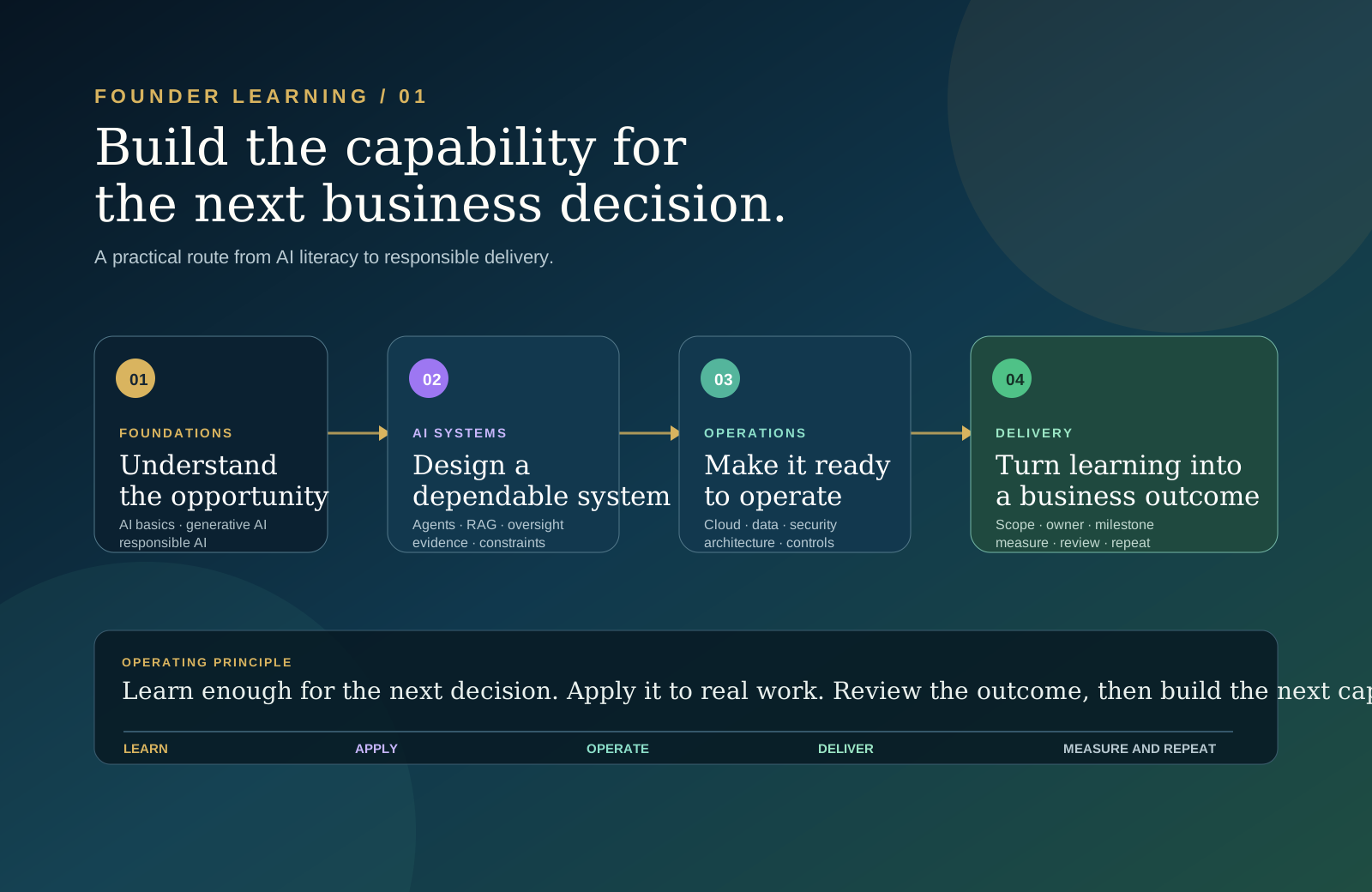
IBM SkillsBuild offers no-cost online learning across AI, cloud, data, cybersecurity, software development, and professional skills. The ten resources below are a practical way to build the judgement behind an AI-enabled business—not just collect badges.
The question is not only, “What stage is the business in?” It is also, “How ready is the business for that stage?” A founder may have market knowledge but need technical depth; another may be strong in product but need an operating model for delivery. The right learning path closes the capability gap before it becomes a growth constraint.
01 / Start with readiness
Build the capability that reduces your next risk
Founders do not begin with identical resources. Experience, capital, customer access, technical confidence, and delivery networks change the route from idea to validation, go-to-market, traction, and growth. The most useful learning plan is not generic: it begins with the capability that could prevent the next milestone.
Choose learning as deliberately as product priorities: start with the constraint that matters most, then practise it on real work.
For an AI product, that may be the fluency to assess feasibility and risk. For a scaling service business, it may be cloud architecture, data protection, or project discipline. The resources below follow that logic.
02 / AI foundations
Learn the language before making product decisions
1. AI Fundamentals
Begin here before choosing an AI feature, vendor, or architecture. IBM SkillsBuild’s AI Fundamentals learning covers core concepts and applications, including machine learning, language, and vision. The aim is not to make every founder a data scientist; it is to develop enough fluency to ask better questions about value, data, cost, limitations, and outcomes.
2. Getting Started with Generative AI
Generative AI is valuable when it improves a real workflow: drafting, classification, retrieval, support, analysis, or content transformation. This foundational pathway explains how generative models and large language models work and where they can help a business. Use it to move from “we need AI” to a clear user problem with a measurable benefit.
3. Ethical Considerations for Generative AI
Responsible AI is a product and operating concern, not a final compliance step. The learning explores transparency, accountability, and fairness; its wider trustworthy-AI themes include robustness, explainability, and privacy. These are practical questions: Can users understand what the system does? Can the team identify failure modes? Is there a safe human escalation path?
03 / AI systems
Move from a model demo to a dependable system
4. The Rise of Multiagent Systems
Agentic systems bring together planning, tools, state, specialised roles, and human oversight. IBM SkillsBuild’s introductory multiagent module is a useful starting point for builders working with AI agents, orchestration, and agent-to-agent communication. Define what each agent may do, what it may access, and where a person must approve consequential action.
5. Retrieval-Augmented Generation (RAG)
RAG connects a language model with external knowledge so it can answer using relevant, current material rather than relying only on training data. Start with Introduction to Retrieval Augmented Generation, then progress to Retrieval-Augmented Generation for Enhanced AI Outputs for use cases, workflow design, evaluation, and more advanced patterns. For a business, the opportunity is trustworthy answers grounded in approved knowledge—not an unconstrained chatbot.
Question → retrieve approved knowledge → rank and cite evidence → generate a constrained answer → human review when risk is high04 / Cloud foundations
Make the underlying system ready to operate
6. Cloud Computing Fundamentals
Cloud decisions quickly become business decisions: they shape speed, availability, security, and cost. The Cloud Computing Fundamentals credential covers service and deployment models, business benefits, and hands-on cloud concepts. It gives founders the grounding to decide what should be managed, bought, or designed deliberately.
7. Hybrid Cloud and modern architectures
Explore Make an Impact with Hybrid Cloud and cloud deployment learning to understand how public and private environments can work together. Add containers, microservices, APIs, and deployment models to the picture. This is relevant where a business must integrate with customer systems, meet data-location needs, or avoid unnecessary lock-in.
8. Data Management and Security in the Cloud
Every AI roadmap is also a data and security roadmap. Introduction to Data Management and Security in the Cloud connects data handling with cloud security. Map what data is collected, who can access it, how long it is retained, how it is protected, and what happens when something goes wrong. Treat identity, access, and data boundaries as part of the product from day one.
05 / Delivery
Turn knowledge into execution
9. Project Management Fundamentals
Technology alone does not build a company. A promising initiative still needs a clear outcome, scope, owners, milestones, risks, resources, and feedback loops. Project Management Fundamentals builds the delivery discipline behind a customer pilot, an AI proof of concept, a cloud migration, or a product launch.
10. IBM SkillsBuild Learning Catalog
The catalog turns individual modules into a personal capability plan. It spans AI, cloud, data, cybersecurity, software development, and professional skills, with routes for adult, university, and high-school learners. Use it to go deeper where the current business stage demands it, rather than attempting every topic at once.
06 / A practical sequence
Build a learning loop around the business
A useful first sequence is: AI Fundamentals → Generative AI → Responsible AI → RAG or multiagent systems → cloud and data security → project management. That gives a founder enough context to evaluate an AI opportunity, prototype it responsibly, and deliver it with a clearer operating model.
Understand the concept and trade-offs.
Turn one lesson into an observable experiment.
Check value, risk, adoption, and what needs to change.
Choose the next capability gap with evidence.
Do not confuse course completion with readiness. Readiness appears when a team makes better decisions, delivers more reliably, protects customer trust, or tests a new idea with less avoidable risk. Start with the constraint in front of the business, learn enough to act, and let the next stage determine the next capability to build.