
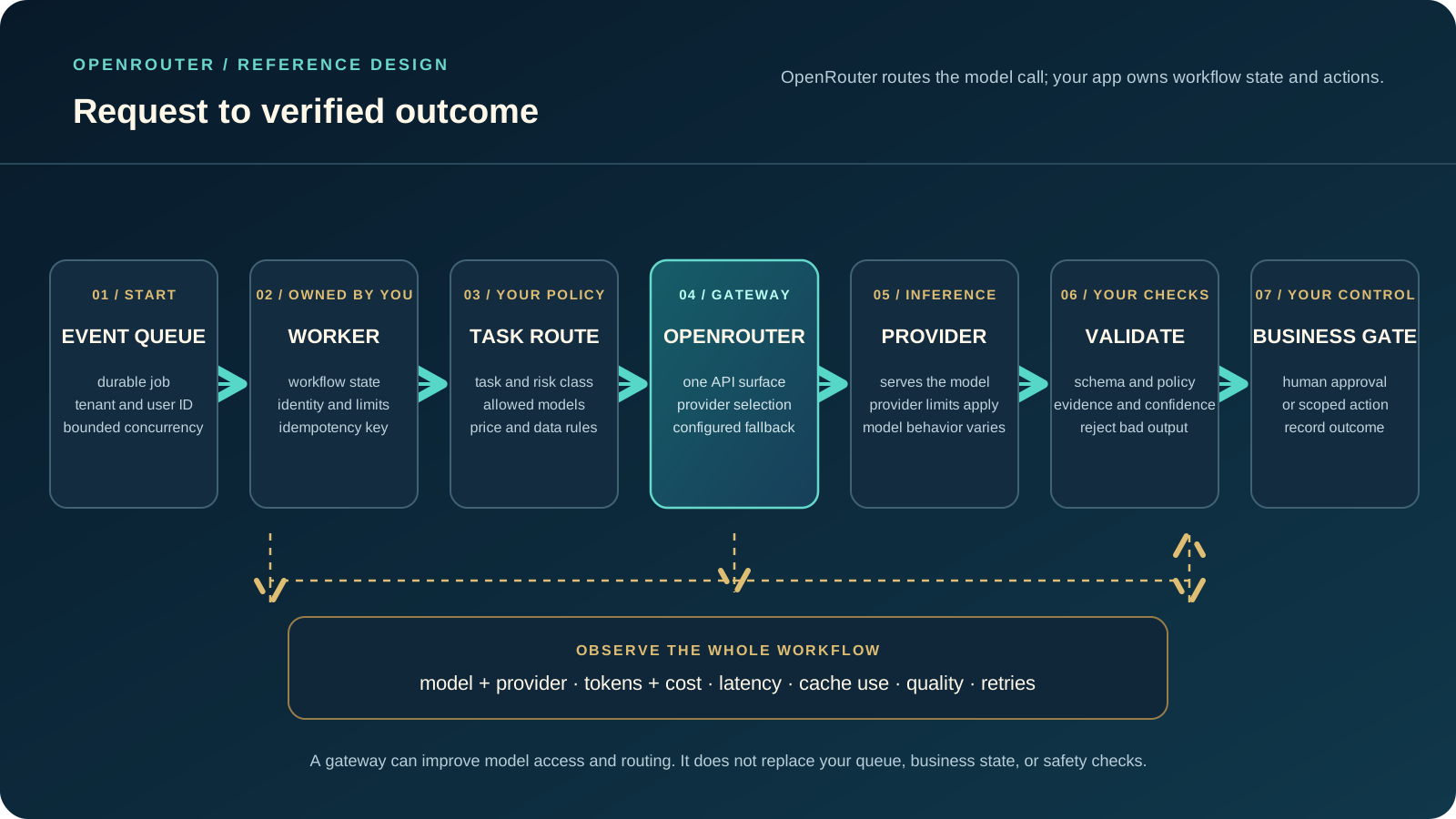
Consider a fictional support ticket, T-1042: “My card was charged twice.” The application stores it as a durable job, checks its shape, and asks an approved model to return a team and urgency. The application may assign the ticket after validation; the model cannot authorize a refund.
Follow this ticket through route policy, provider inference, a possible cache hit or fallback, validation, and a recorded outcome.
The same ticket grounds each design choice below. All numbers in the cost example are invented teaching rates, while the product behavior is linked to current OpenRouter documentation.
01
OpenRouter is a model gateway and routing layer
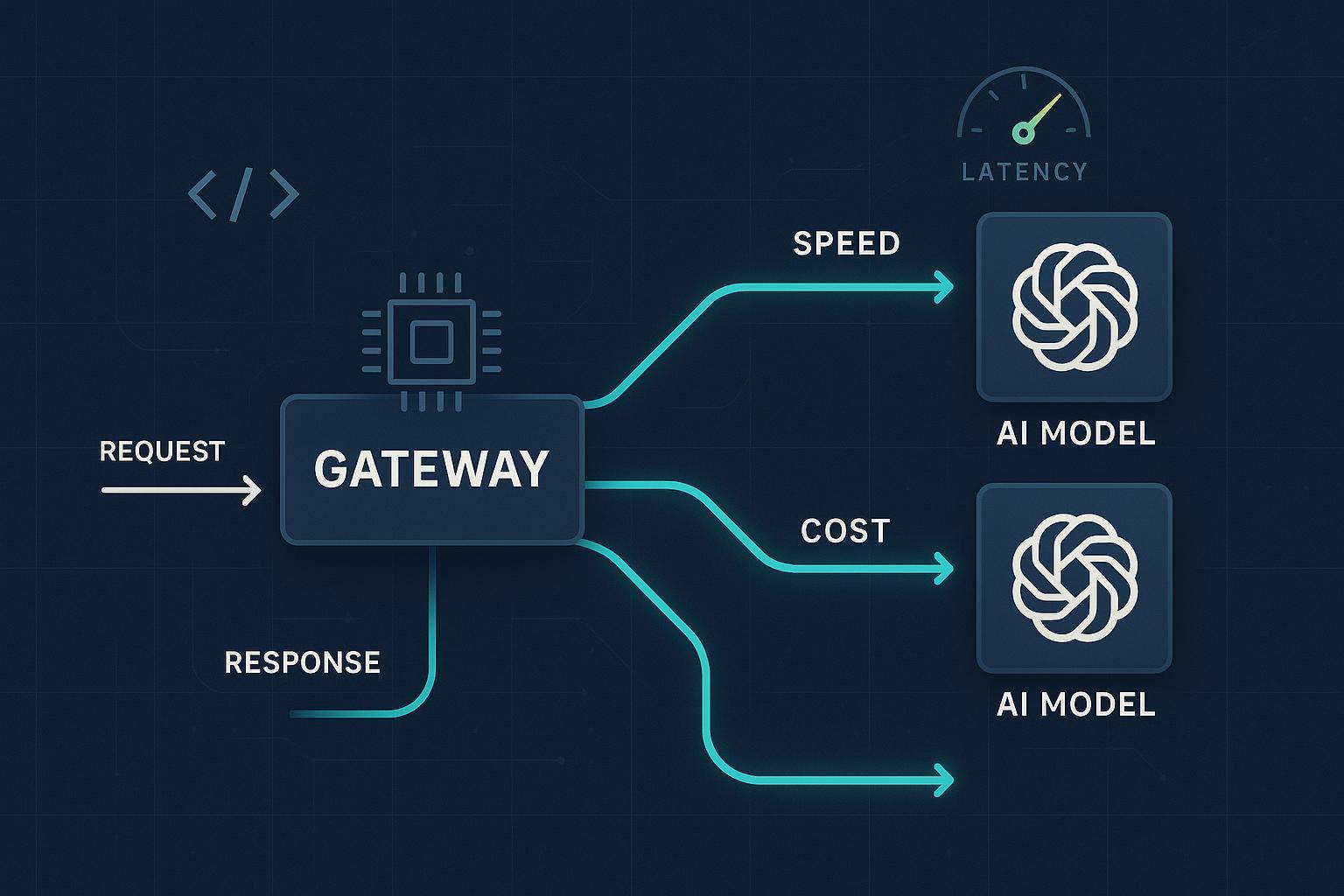
An application sends a request to OpenRouter’s API with a model choice and prompt. OpenRouter then routes that inference request to a provider that serves the model, subject to the provider and model rules in the request or account. This gives an application one integration surface across many models and providers, with controls for provider preference, price, latency, throughput, and eligible fallback behavior. The current behavior is described in the official provider-routing documentation.
There are two decisions to keep separate. Model routing chooses which model should handle the task. Provider routing chooses where that model runs. You can choose the model yourself, delegate model choice to a router such as OpenRouter Auto, and separately constrain which providers may serve it.
02
What OpenRouter solves—and what it leaves to you
When each model vendor has a different endpoint, account, parameter set, and failure behavior, a growing application can accumulate provider-specific integration code. OpenRouter centralizes the model-call boundary and gives the team a place to make routing choices.
One model access surface
Use a common API entry point to try supported models and providers without building a separate connection for every candidate. This reduces integration friction; it does not erase differences in model capabilities or request parameters.
Change route policy without rewriting the workflow
Adjust an approved model, provider preference, or performance/cost sorting rule at the inference boundary. The business workflow can keep its own stable request and response contract.
Handle selected provider failures
Provider routing and configured model fallbacks can recover from some availability and rate-limit failures. They reduce custom routing code, while your application still controls timeouts, durable retries, and what happens after the fallback list is exhausted.
Compare model use and spend
A shared activity and generation record can make it easier to see which provider/model ran, how many tokens it used, and what the request cost. Join those records to your own workflow outcome to see whether the AI step solved the task.
03
A documentation-backed reference design for one ticket
The hero diagram combines documented OpenRouter capabilities with ordinary application controls. The ticket trace below shows where each decision happens. Documentation supports the described features; accuracy, latency, and throughput for this workflow still need measurement.
- Store the jobSave the ticket and its tenant scope before calling a model.
- Choose the routeApprove a model and set provider, data, and spend limits.
- Run inferenceOpenRouter serves the call, possibly using an eligible fallback.
- Check the resultValidate team and urgency; send uncertain results to review.
- Act once and measureAssign the ticket once and record outcome, latency, and charge.
Before inference, the worker records T-1042, its tenant scope, allowed action, and retry budget. It keeps the API key on the server, applies data and spend rules, and selects an approved model and provider policy for ticket classification.
After inference, the application accepts only an allowed team and urgency value. An invalid or uncertain result goes to review. A valid “billing” result may assign T-1042 once, using its ticket ID as the idempotency key; it never authorizes a refund.
04
Four routing patterns cover different needs
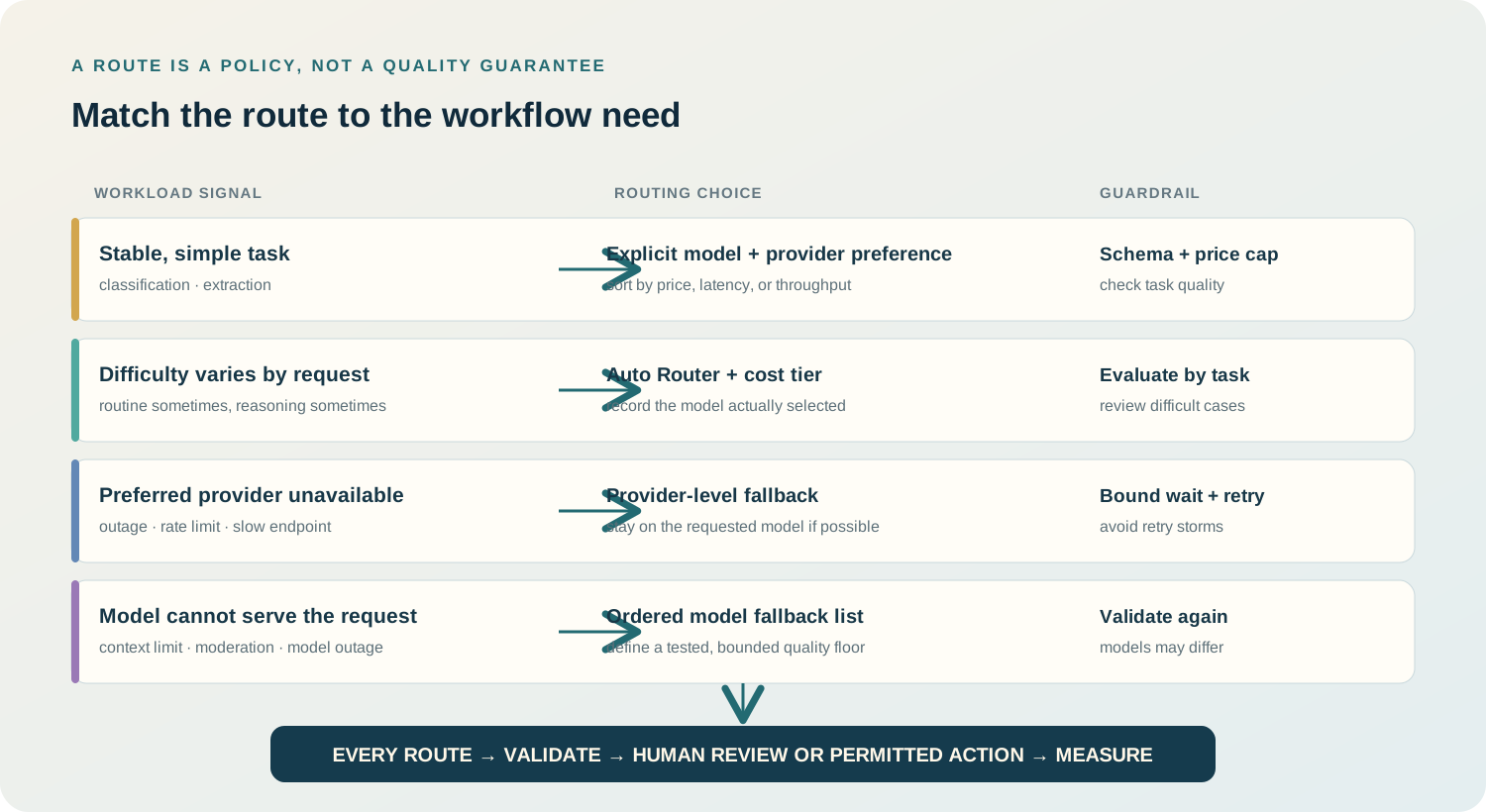
OpenRouter routing is easiest to reason about as two layers: choose a model, then choose a provider that can serve it. The patterns below can be combined, but each changes a different part of the decision.
Fixed model, flexible provider
For a routine ticket such as T-1042, name the model your evaluation has approved. OpenRouter can use default provider routing or a preference; you can sort by price, latency, or throughput, constrain price, and allow or exclude providers. This keeps the task policy explicit while serving the same model through eligible endpoints.
Automatic model choice
Send work to OpenRouter Auto when difficulty varies across requests and you want the router to select a model. The current Auto router uses task classification and recent community spend, with cost tiers from low to max. Its choice can change as usage and available models change, so log the model actually selected and evaluate outcomes over time.
Provider fallback
If the chosen provider cannot serve T-1042, provider routing can try another eligible endpoint for the same model, subject to your settings. That recovery can add latency. Record the provider that actually answered, not only the preferred provider.
Model fallback
An ordered model list can move to another model when a supported failure occurs, such as a provider error, rate limit, or certain model-level rejection conditions. A fallback is not an answer-quality upgrade: the new model can produce different text, use different tools, or have different context limits. Validate it as a separate route.
The official docs explain the available provider settings, the behavior of Auto, and the eligible fallback cases. Use them to configure the exact route you intend: Auto Router overview and model fallback guide.
05
Routing, two caches, and token accounting
For T-1042, each mechanism changes a different part of the call or its measurement. Separate the four controls before estimating spend.
| Mechanism | Effect | Measure |
|---|---|---|
| Routing | Chooses an eligible model or serving provider. | Accepted outcome, latency, and cost by route. |
| Prompt caching | Discounts supported repeated input prefixes. | Cached input tokens and effective input rate. |
| Response caching | Replays cached answer content before inference. | HIT/MISS rate, age, and billed request cost. |
| Token accounting | Forecasts and reconciles inference charges. | Actual generation cost per accepted ticket. |
For calls that reach a provider, estimate the token charge with rates per million tokens:
(uncached input tokens × input rate + cached input tokens × cache-read rate + output tokens × output rate) ÷ 1,000,000Include uncached input, discounted cache reads where supported, output and billable reasoning tokens, plus any tool or auxiliary charges. Estimate every permitted Auto or fallback path. OpenRouter charges its platform fee when credits are purchased, rather than as a fee on each request. Failed fallback attempts are not charged for model tokens, although an auxiliary service that already ran may still be billed. Reconcile estimates with the final generation record.
Provider prompt caching reuses a stable input prefix, such as shared instructions, when the selected model and provider support it. Cache-read prices, write costs, minimum prompt size, and expiry vary. OpenRouter uses provider stickiness and supports `session_id` to improve reuse across turns; a change in provider or prompt can still miss the cache. Read the prompt-caching guide. Put stable instructions before changing ticket content when the model permits it, and measure cached input tokens instead of assuming a hit.
OpenRouter also offers optional response caching before a provider call. If the API key, model, endpoint, streaming mode, and request body match a cached successful call, it returns the saved answer with a new generation ID and zero billable tokens. The default expiry is five minutes. Account-level Zero Data Retention disables this cache, and the application still must prevent duplicate business actions. Read the response-caching guide.
Assume T-1042 uses 2,000 input and 200 output tokens. Earlier tickets may have warmed its shared prompt prefix; an exact retry may hit the response cache. Illustrative USD rates per 1 million tokens: primary input $0.20, cache read $0.05, primary output $0.80; fallback input $1.00, fallback output $4.00. These are teaching rates, not current model quotes.
The failed model attempt adds no model-token charge, but recovery can increase latency. Tool charges and credit-purchase fees are outside these request figures.
For T-1042, join the job ID to the generation record: actual model and provider, input and output tokens, total cost, latency, and cache details where available. Capture the response-cache HIT or MISS header separately. OpenRouter exposes generation usage records for this purpose. Compare cost per correctly assigned ticket, including review work, against the baseline; check the current pricing page.
06
How this helps build highly scalable workflows
OpenRouter can route the inference step across eligible providers. The queue, worker limits, and action gate determine how many tickets the complete system can process safely.
- Put incoming work on a durable queue and let a worker pool process it with a measured concurrency limit. Persist job state before and after each model call so a worker restart resumes the job instead of losing it or silently starting a duplicate.
- Give each step a purpose and route policy. Reject malformed tickets without inference. Use an evaluated economical model for routine classification, with a stronger permitted route or human review for ambiguous cases. Apply provider, data, and price rules before sending a ticket.
- Use provider routing and bounded fallbacks to absorb selected provider outages and rate limits. Keep a timeout, exponential backoff with jitter, an overall retry budget, and a circuit breaker in the application. A successful gateway fallback does not remove the need to control queue growth or respect downstream quotas.
- For repeated multi-turn prompts, keep the shared prefix stable and use a consistent session identifier where appropriate. Watch cached-token usage and latency alongside ordinary token counts. If provider stickiness conflicts with a newer privacy or routing constraint, honor the constraint and accept a cache miss.
- Measure outcomes by workflow step and tenant: completion rate, p50/p95 latency, selected model and provider, input/output/cache tokens, cost per successful task, retry rate, validation failures, and human-review rate. Apply spend limits and alert on drift before expanding worker concurrency.
T-1042 is complete only after a single assignment or a recorded decision to send it for review. If a worker retries, a provider fallback succeeds, or a cached answer is replayed, the application checks the same job ID before acting. This keeps inference recovery from creating duplicate assignments.
07
Limitations and trade-offs to plan for
A common API surface does not make models identical. Providers can differ in parameter support, tool calling, structured output, context limits, moderation, latency, and price. Provider routing can change where a request runs; model fallback can change what generated the answer. Maintain evaluations for each route you permit, and inspect the model and provider that actually served a request.
Fallback is bounded recovery, not a guarantee that every call succeeds or that the next route is equivalent. It can add latency and cost complexity. Invalid requests, application bugs, a full queue, or an unavailable compliant provider still need an explicit application outcome. Do not build unbounded retries on top of gateway retries.
A request passes through OpenRouter and the selected inference provider, so treat both as part of your data boundary. OpenRouter documents provider controls for data collection, zero data retention, and regional routing, but those controls constrain availability and are not a substitute for checking provider terms, account settings, contracts, and your own compliance obligations. See its privacy and data-routing documentation.
Response caching can replay a completion containing tool calls. Treat that as a reused inference result and keep authorization and idempotency at the application action gate. Auto selections and prices can change; the gateway remains a dependency to monitor.
08
A practical rollout
Start with one bounded, low-impact workflow step. Establish a baseline before changing routes, then expand only when the route meets the same quality, latency, privacy, and cost requirements as the current path.
1. Measure the current call
Capture representative inputs, output quality, token use, latency, errors, and cost per completed task. Keep a fixed model as a comparison point.
2. Evaluate candidate routes
Test explicit provider routing, Auto, or a fallback list against the same cases. Check tool use, structured output, refusal behavior, data rules, and total workflow cost—not just a few attractive answers.
3. Canary and widen
Route a small share of live work, compare the selected model and business outcome, and define a rollback threshold. Increase traffic gradually while watching the queue, rate limits, cache hit rate, and review workload.
Start with one measured ticket step. Keep route policy and cache rules explicit, compare cost per accepted outcome, and expand only when quality, latency, privacy, and recovery meet your requirements.
Stay up to date
Get new engineering notes by email.
Occasional, practical writing on engineering, automation, data, and product strategy.