
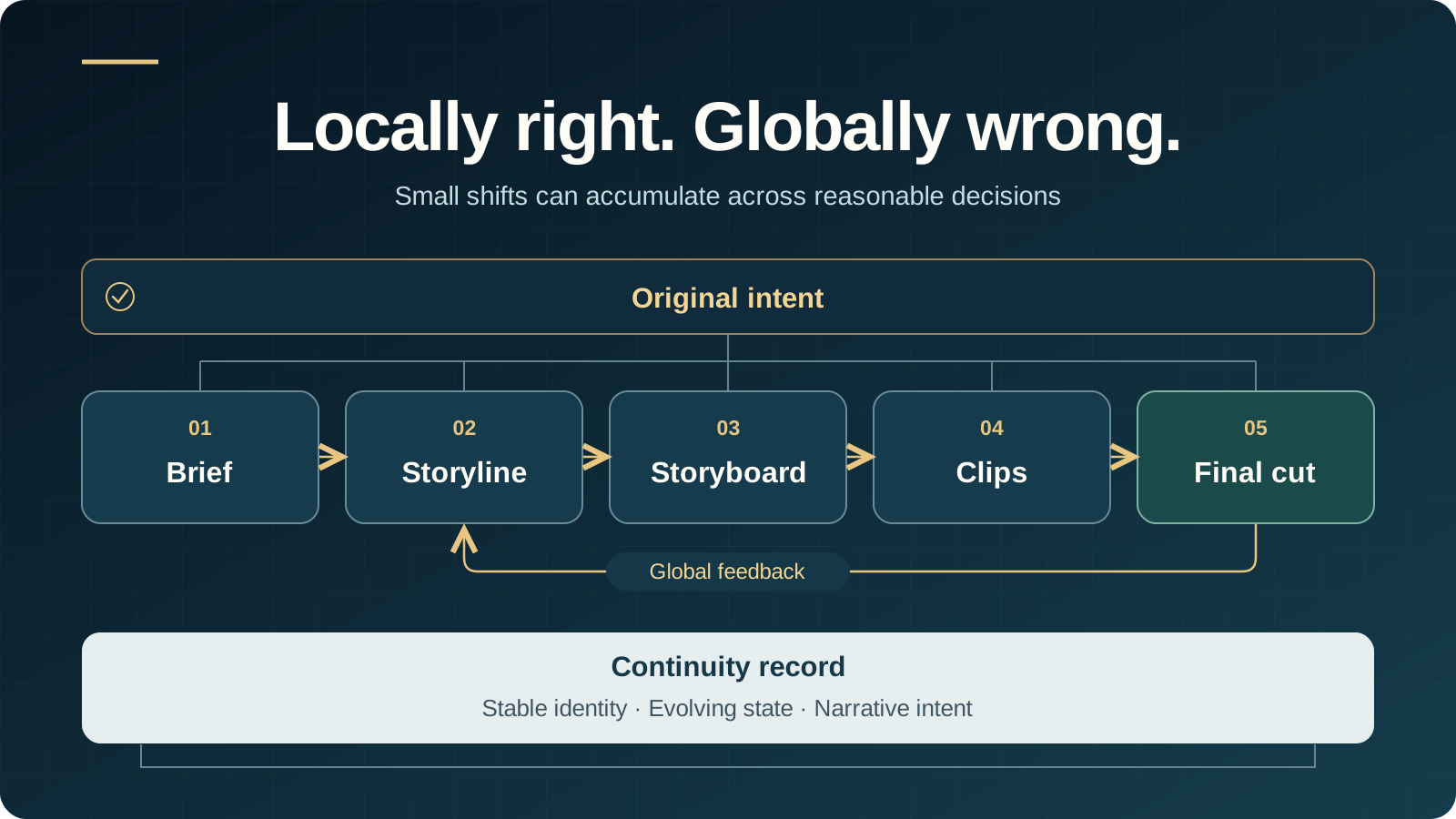
The most dangerous workflow failure may be one in which every step looks reasonable.
The script follows the brief. The storyboard follows the script. Each generated clip follows its storyboard frame. Yet the finished film no longer tells the story the creator asked for.
This is semantic drift: meaning changes gradually as work moves between people, agents, models, and tools. No single handoff needs to be obviously broken. A detail is softened in a summary, reinterpreted during planning, simplified in production, and accepted by a reviewer who sees only the latest output. The workflow finishes successfully while its purpose has moved.
Google Research's work on coherent long-form video makes this problem unusually visible. A character changes clothes, a room rearranges itself, or an object returns in the wrong condition. The same pattern appears less visibly in research, customer service, marketing, logistics, and document workflows. The business examples in this article are design interpretations; the reported measurements belong to the video studies themselves.
Intent usually disappears by degrees
Imagine a creator requests a ten-scene story about a cautious engineer who gradually learns to trust her team. The story agent turns that into a scene outline. A visual agent creates references. A video agent renders each shot. An editing agent assembles the result. Each participant receives a narrower description than the one before it.
By scene seven, the engineer may still have the same face, but her cautious behaviour has vanished. The individual clip is attractive and matches its immediate prompt. The narrative arc is wrong because a story-level property was lost between stages. Visual identity survived; narrative identity did not.
This distinction matters beyond video. A sales workflow can preserve a customer's name while losing the reason they asked to be contacted. A research workflow can preserve quotations while weakening an important qualification. A support workflow can resolve a ticket while overlooking the outcome the customer actually needed. Correct fields do not guarantee preserved meaning.
Semantic drift is the widening distance between the current output and the original intent, even when each intermediate output appears acceptable on its own.
Video research separates four parts of the problem
Google Research's September 2026 overview brings together four related frameworks. They should be understood as separate research contributions, not as one benchmarked product. Together, they show that long-form consistency requires more than a powerful generator. Read the Google Research overview.
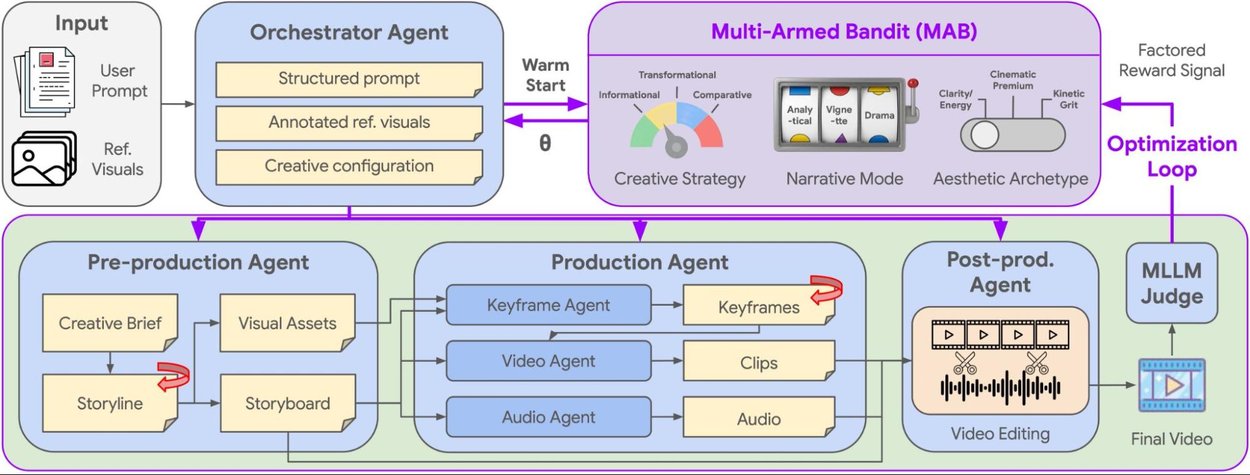
Co-Director: keep one creative direction across agents
Co-Director treats storytelling as a global optimization problem. An orchestrator translates a selected creative direction into instructions for pre-production, keyframe, video, audio, and editing agents. A multimodal judge scores the assembled result and returns a factored reward signal. In its main four-shot, 12-second advertising experiment, Co-Director scored 81.4/100 compared with 75.7 for random search using the same four-run budget. Those are aggregate benchmark scores, not success rates. Read the paper.
CANVAS: remember the world, not just the last image
CANVAS maintains structured representations of characters, locations, and props. When a museum hall returns after several other scenes, the system can retrieve its established geometry and the current state of the stolen object. The paper reports improvements over its strongest baseline in background, character, and prop continuity, while acknowledging limitations in complex motion, physical interactions, and ambiguous narratives. Read the paper.
A²RD: balance progression with consistency
A²RD generates a long video segment by segment through a retrieve, synthesize, refine, and update cycle. It switches between extrapolation, which advances the story, and interpolation, which anchors returning entities and environments. Its long-duration evaluation includes ten 10-minute scenarios. This is where the overview's minutes-long evidence comes from; it should not be attributed to Co-Director's short advertising experiment. Read the paper.
VQQA: correct defects without abandoning the request
VQQA asks questions about a generated video, uses visual-model answers as natural-language feedback, revises the prompt, and generates another candidate. Its global selector compares every candidate with the original prompt so a local improvement does not quietly replace the broader request. It remains limited by the judgement model and the underlying video generator. Read the paper.
Three different failures can look like one
Calling every inconsistency 'drift' hides where the process needs help. A useful review separates three failure modes.
| Failure | What changed | Video example |
|---|---|---|
| Identity drift | An entity loses attributes that should remain stable. | A character's face, clothing, or voice changes unintentionally. |
| State drift | The workflow forgets how the world changed earlier. | A broken window returns intact, or a stolen object reappears in its case. |
| Intent drift | The output remains polished but moves away from the requested purpose. | A reflective story becomes an action montage because each scene was optimized for visual excitement. |
The first two failures are easier to see and measure. Intent drift is harder because the final result may still be coherent, attractive, and internally plausible. The question is no longer 'Is this output good?' but 'Is it still the right output for this request?'
Cascading failure is what happens when a drifted artifact becomes trusted input. If a storyboard gives the protagonist the wrong coat, every later clip can reproduce that coat perfectly. Downstream consistency then strengthens an upstream mistake.
Local correctness is necessary—and insufficient
Most pipelines check the output of one stage against the input to that stage. Did the storyboard match the storyline? Did the clip match the keyframe? Those checks are valuable, but they only inspect adjacent links. A sequence can pass every local comparison while moving farther from the original brief.
Long workflows therefore need two views. Local checks ask whether a stage completed its immediate assignment. Global checks ask whether the assembled work still preserves the invariants, progression, and purpose established at the beginning.
| Level | Question | What it catches |
|---|---|---|
| Local | Does this output satisfy the current stage's input? | Missing fields, malformed output, obvious prompt mismatch, and defects within one artifact. |
| Global | Does the complete trajectory still satisfy the original intent and current world state? | Accumulated reinterpretation, conflicting scenes, abandoned constraints, and a story that no longer progresses as intended. |
The global check cannot be postponed entirely until the end. Video generation is expensive, and a flawed character sheet can contaminate dozens of clips. Place checkpoints before costly or irreversible transitions: after the storyline, across the keyframe sequence, and again on the assembled cut. The aim is to contain drift near its source.
Preserve continuity with a compact world model
A transcript of everything the workflow has seen is not the same as useful memory. Long context can contain abandoned ideas and conflicting descriptions. What agents need is a maintained continuity record: a compact account of what should remain stable, what has changed deliberately, and what the story has yet to resolve.
The record must distinguish continuity from rigidity. A coat changing without explanation is drift; a coat changing after the character enters a rainstorm may be correct progression. The system needs the event that explains the change, not a rule that every frame must remain identical.
This is the most transferable lesson for other automation. Store meaning in a form that the next stage can inspect: stable requirements, authorised changes, unresolved questions, and source references. Your earlier articles cover the operational controls around that record—approval, evidence ownership, retries, and verified execution. The continuity problem addressed here is narrower: ensuring each transformation preserves the right meaning.
Feedback must point back to the original intent
A critic that sees only the latest output can improve the wrong thing. It might make a scene more cinematic while weakening the quiet tension the creator requested. Useful feedback compares the candidate with three references: the immediate stage requirements, the current continuity record, and the original brief.
Make critiques specific enough to guide a decision. 'The character is inconsistent' is vague. 'The red scarf established in scenes one and three is absent when the character returns in scene eight, without a story event explaining its removal' identifies the entity, prior evidence, location of failure, and missing justification.
Then decide the smallest safe correction. Regenerate the affected frame if the problem is local. Revisit the storyboard if several scenes share the same misunderstanding. Reconsider the storyline if the emotional arc itself has drifted. Fixing the last visible symptom may preserve the cause.
Keep accepted work while exploring revisions. VQQA's global selection embodies this idea: compare candidates across the optimization path instead of assuming the last attempt is best. A correction can solve one defect and introduce another, so progress should be measured against a stable reference.
Evaluate trajectories, not isolated outputs
A final-video score tells you whether the process ended well. It does not reveal where meaning began to move. For a useful evaluation set, record the original brief, approved continuity state, intermediate artifacts, critiques, revisions, and final output. Review the path as well as the destination.
Test deliberate change and accidental drift separately. Ask a character to change clothing after a visible event, then return to an earlier location much later. A strong system should preserve the location, apply the authorised clothing change, retain object-state history, and continue the intended narrative arc. Merely making every frame similar would fail the test.
Identity persistence
Do recurring people, objects, and locations retain the attributes that should remain stable?
State accuracy
Do later scenes reflect changes caused by earlier events, including after long gaps?
Narrative progression
Does each segment advance, deepen, or intentionally pause the story rather than repeat it?
Intent preservation
Does the complete work still deliver the original purpose, tone, and constraints after all transformations?
Automated judges can scale these reviews, but they are part of the system being evaluated. Validate important scoring dimensions with people, inspect disagreements, and state what a benchmark actually measures. Co-Director's authors found weaker agreement between their multimodal judge and people on visual quality than on some narrative dimensions—a useful reminder that a score is a model of quality, not quality itself.
The better question is what must survive transformation
The central design challenge in multi-agent work is not simply passing more context. It is deciding which meaning must survive each transformation, which changes are legitimate, and how the system will detect the difference.
Before adding another agent, identify the invariant it receives, the decision it may make, the state it must update, and the evidence the next stage will use. Then define a global checkpoint that reconnects the combined work to the original purpose. This makes every handoff accountable for continuity, not merely completion.
The video research points toward a broader principle: intelligence at each step does not create coherence by itself. Coherence comes from a shared model of the world, feedback anchored to intent, and evaluation across time. A workflow becomes dependable when it can explain both why something changed and why the result still belongs to the request that started it.
Stay up to date
Get new engineering notes by email.
Occasional, practical writing on engineering, automation, data, and product strategy.